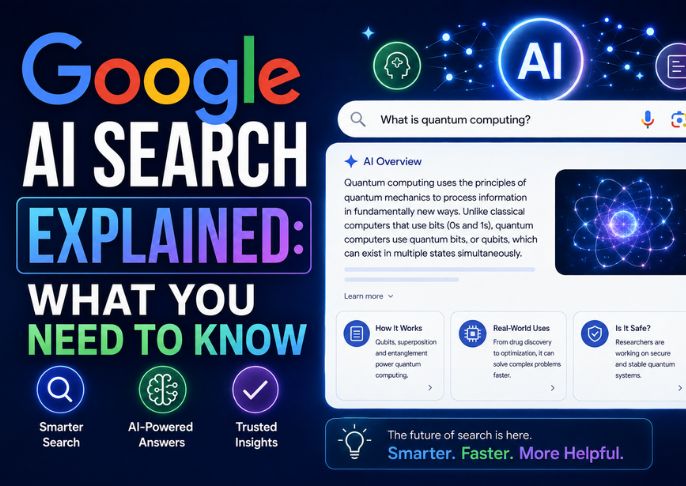
Google AI Search is changing the way people discover information online. Instead of relying only on traditional blue-link search results, Google’s AI-powered search features can provide summaries, explanations, follow-up information, and more conversational ways to explore a topic.
For users, this means search is becoming more interactive. For publishers, marketers, and SEO professionals, it also means that creating helpful, trustworthy, and well-structured content is becoming increasingly important.
At zvodeps.com, we cover technology, AI, SEO, and digital trends. In this guide, we explain what Google AI Search means, how it works, what users can expect, and why it matters for websites.
What Is Google AI Search?
Google AI Search refers to Google’s use of artificial intelligence to improve the search experience. Rather than simply matching keywords with webpages, AI can help understand the meaning and context behind a user’s query.
This can make it easier to answer complex questions, compare information, explore different subjects, and continue a search with follow-up questions.
For example, instead of searching several separate queries about a product, a user may ask a more detailed question and receive an AI-generated response that brings relevant information together.
How Does Google AI Search Work?
Google AI Search uses artificial intelligence and Google’s search systems to understand queries and identify relevant information.
A traditional search might return a list of webpages for a query. AI-powered features can go further by interpreting the question, identifying relevant concepts, and generating a response based on information available to the system.
The technology is designed to help users with more complicated searches that may require multiple steps.
However, AI-generated answers can still contain mistakes. Users should verify important information, especially when dealing with financial, legal, medical, or other high-stakes subjects.
AI Overviews and Search Results
One of the most visible developments in Google AI Search is the use of AI-generated summaries within search results.
These summaries can appear for certain queries and are designed to provide users with a quick overview before they explore individual webpages.
The traditional search experience has not disappeared. Search results, websites, images, videos, maps, and other features can still provide additional information.
For website owners, appearing as a source or being visible within search remains an important part of online visibility.
Why Is Google AI Search Important for SEO?
The growth of Google AI Search is important for SEO because users may interact with search results differently than they did in the past.
Instead of clicking the first result immediately, users may first read an AI-generated overview and then decide which sources deserve further attention.
This means websites need to focus on more than simply placing keywords on a page.
Important areas include:
- Helpful and original content
- Clear answers to user questions
- Strong topical relevance
- Logical content structure
- Good user experience
- Accurate information
- Strong internal linking
- Clear authorship and expertise
Does Google AI Search Replace Traditional SEO?
No. Google AI Search does not mean traditional SEO is suddenly irrelevant.
Fundamental SEO principles such as crawlability, indexability, relevant content, technical performance, internal linking, and useful page structure remain important.
However, AI-powered search makes search intent and content quality even more important.
A page should be written for people first while making it easy for search systems to understand the subject.
How Can Websites Prepare for Google AI Search?
Businesses and publishers can adapt to Google AI Search by creating content that directly addresses genuine user needs.
Start by understanding what your audience actually wants to know. Then create comprehensive content that answers the main question while covering related questions naturally.
Useful strategies include:
Answer Questions Clearly
Don’t hide the main answer behind unnecessary introductions. Give readers useful information early and then provide additional detail.
Build Topic Authority
Instead of publishing isolated articles on unrelated keywords, develop useful content around connected topics.
Add Original Value
AI-generated content is widely available. Websites can stand out by adding first-hand experience, original research, examples, expert commentary, data, or unique analysis.
Keep Content Updated
Information can become outdated quickly, especially in technology. Regularly review important pages and update information when necessary.
Will Keywords Still Matter?
Keywords remain useful because they help search engines understand the subject of a page. However, modern search is increasingly capable of understanding concepts and context.
For example, a page about “best laptops for students” may naturally include related concepts such as battery life, performance, portability, price, operating system, and screen size.
Rather than repeating one keyword excessively, writers should cover the topic comprehensively.
What Does Google AI Search Mean for Content Creators?
For bloggers and publishers, Google AI Search creates both challenges and opportunities.
The challenge is that some users may receive answers directly within search results without visiting a website.
The opportunity is that high-quality websites can potentially become sources that search systems use when generating answers or recommending information.
This makes reputation, content quality, expertise, and originality increasingly valuable.
How Users Can Get Better Results
Users can also improve their experience with Google AI Search by writing specific questions.
Instead of searching for:
“SEO”
try:
“How can a small business improve its local SEO in 2026?”
A detailed query gives the search system more context and can produce a more useful response.
Follow-up questions can also help users refine their search and explore a topic from different perspectives.
What Are the Limitations?
Despite its benefits, Google AI Search has limitations.
AI systems can misunderstand questions, provide incomplete answers, or generate information that requires verification. Search users should therefore avoid assuming that an AI-generated response is automatically correct.
For important decisions, it is better to examine the underlying sources and compare information from reliable websites.
Website owners should also remember that appearing in an AI-powered search feature is not guaranteed. Search visibility can change based on query, location, device, content, competition, and Google’s evolving systems.
The Future of Search
The development of Google AI Search suggests that online search will continue moving toward more conversational and interactive experiences.
People may increasingly use search engines as research assistants rather than simply as directories of webpages.
For businesses and publishers, this makes it important to create content that is genuinely useful and demonstrates expertise.
The future of search is unlikely to be about choosing between AI and traditional search. Instead, both approaches are likely to work together, with AI helping users understand information and traditional webpages providing deeper details and original sources.
Final Thoughts
Google AI Search represents a major development in how people discover and interact with information online. AI-powered features can make complex searches easier, provide quick explanations, and help users explore topics through conversational interactions.
For website owners, the key lesson is simple: focus on creating valuable, accurate, original, and well-structured content rather than trying to manipulate AI search systems.
SEO fundamentals still matter, but content quality and user intent should remain at the centre of your strategy.
For more AI, SEO, technology, and digital marketing guides, visit zvodeps.com.
Also Read: 10 Best AI Chrome Extensions to Boost Productivity